
Wedding stationery is the first taste your guests will have of your event, and the wording is as important as the design. The language you choose establishes the tone of your celebration before your guests ever arrive. Intentional choices in wording can make an invitation feeling traditional and formal, modern and understated, or personal and playful.
Wedding Etiquette 101
When it comes to wedding wording, the now out of print Crane’s Blue Book of Stationery is a wonderful reference for understanding the traditions of formal correspondence. There are conventions around how names are written, the format of dates and times , and which phrases are appropriate for different types of ceremonies. These details may seem small, but they have a meaningful impact on the overall presentation of your stationery.
At Robinson Press, we believe in understanding the rules before deciding which ones to reinterpret. Below we’re sharing some of the specific wording conventions worth knowing as you begin planning your save-the-dates, invitations, and ceremony programs.
Caroline Ro Photography
1. Save the Dates
Save the dates are less prescriptive than formal wedding invitations, which means there’s more freedom in how you approach the wording. That said, there are a few conventions worth keeping in mind, particularly if you want your stationery to feel cohesive from the first announcement through the wedding day.
The simplest wording is often the most effective. “Save the Date” followed by the couple’s names, the wedding date, and the location are really all you need. For a more formal presentation, you might write “Please save the date for the wedding of” before listing the couple’s full names. One detail we recommend paying close attention to is the phrase at the bottom of the card. “Formal invitation to follow” is a traditional, polished option while “Invitation to follow” is equally clear but more understated. Now’s the time to consider the tone you want to establish for your invitations and your event as a whole.
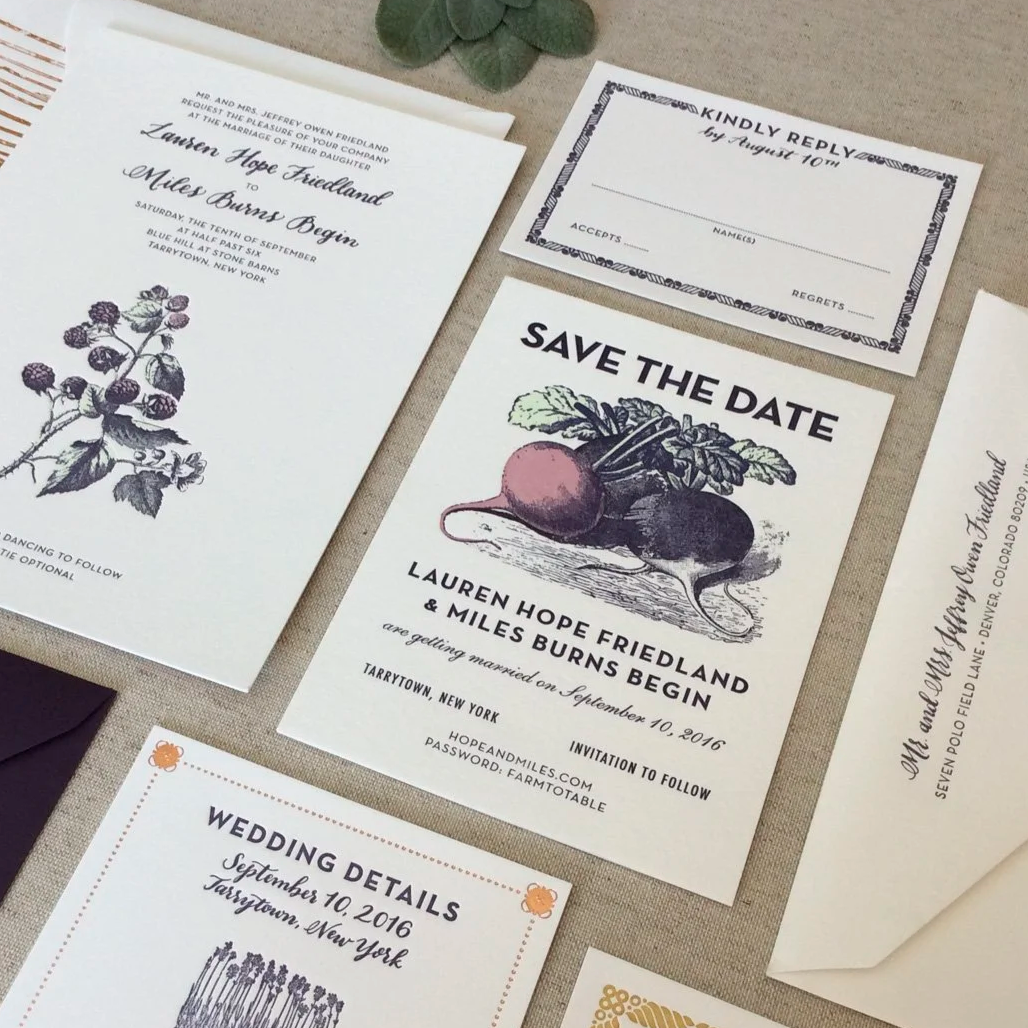
Photo by Robinson Press
A few specific save-the-date wording details to consider:
“Wedding” versus “marriage.” “Save the Date for the wedding of…” is direct and familiar. “Save the Date for the marriage of…” has a more traditional, formal feeling. Neither is inherently incorrect, the distinction is stylistic.
Full names versus first names. Full names are a natural choice for a more formal save the date, first names can feel more intimate and relaxed, and middle names are optional on save the dates.
How to write the date. “Saturday, May 15, 2027” is a clear, contemporary presentation. “Saturday, the fifteenth of May, two thousand twenty-seven” follows a more traditional formal style. Start to think about the tone of your wedding invitations, if you want those formal, make sure your Save the Date matches.
How to write the location. “Charleston, South Carolina” is generally sufficient. The full ceremony venue and street address can be saved for the invitation.
Here is an example of a simple, traditional save-the-date:
Save the Date for the wedding of
Althea Rose Smith
and
Jerome Alexander Wilson
Saturday, the fifteenth of May, two thousand twenty-seven
Charleston, South Carolina
Formal invitation to follow
Notice that the wording is intentionally brief. There is no need to name the hosts, include an attendance request, or provide a full schedule of events. Those details belong elsewhere in the stationery suite.
2. The Wedding Invitations
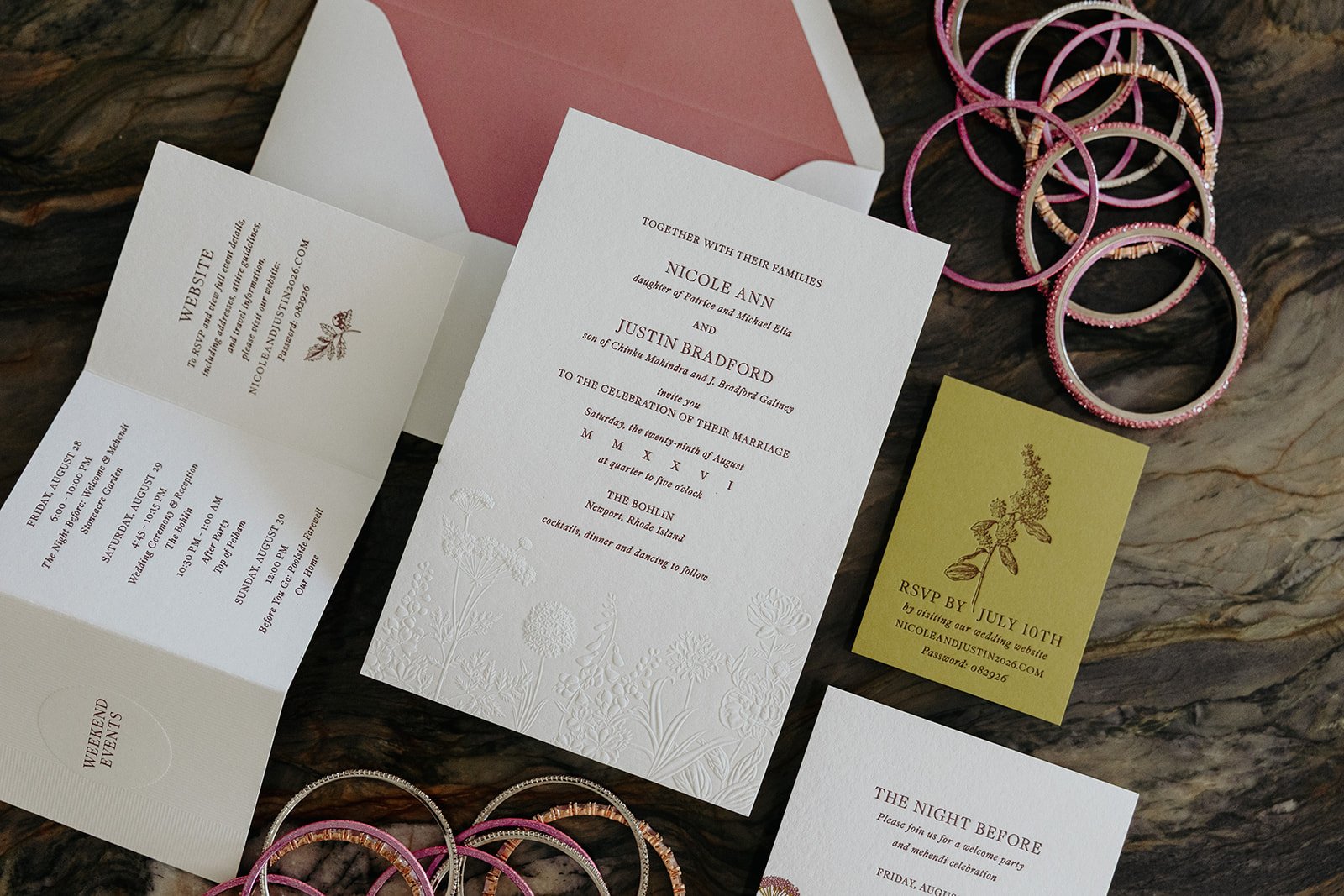
Formal wedding invitations have more established wording conventions, and this is where understanding traditional etiquette becomes especially useful. The order of the names, the language used to request guests’ attendance, and the formatting of the date and time all contribute to the formality of the invitation.
Who is named first?
Traditionally, a wedding invitation begins with the name or names of the hosts. Historically, this was often the bride’s parents, but contemporary invitations may name one set of parents, both sets of parents, the couple, or the couple together with their families.
If the bride’s parents are hosting, a traditional opening might read:
Mr. and Mrs. William Smith
request the honor of your presence at the marriage of their daughter
Althea Rose
to
Mr. Jerome Alexander Wilson
In this traditional format, when the bride shares her parents’ surname, her surname is generally omitted from her name line. Her parents’ surname has already appeared in the host line. The groom’s full name, including his title in a traditional formal format, follows.
Asia Pimental Photography
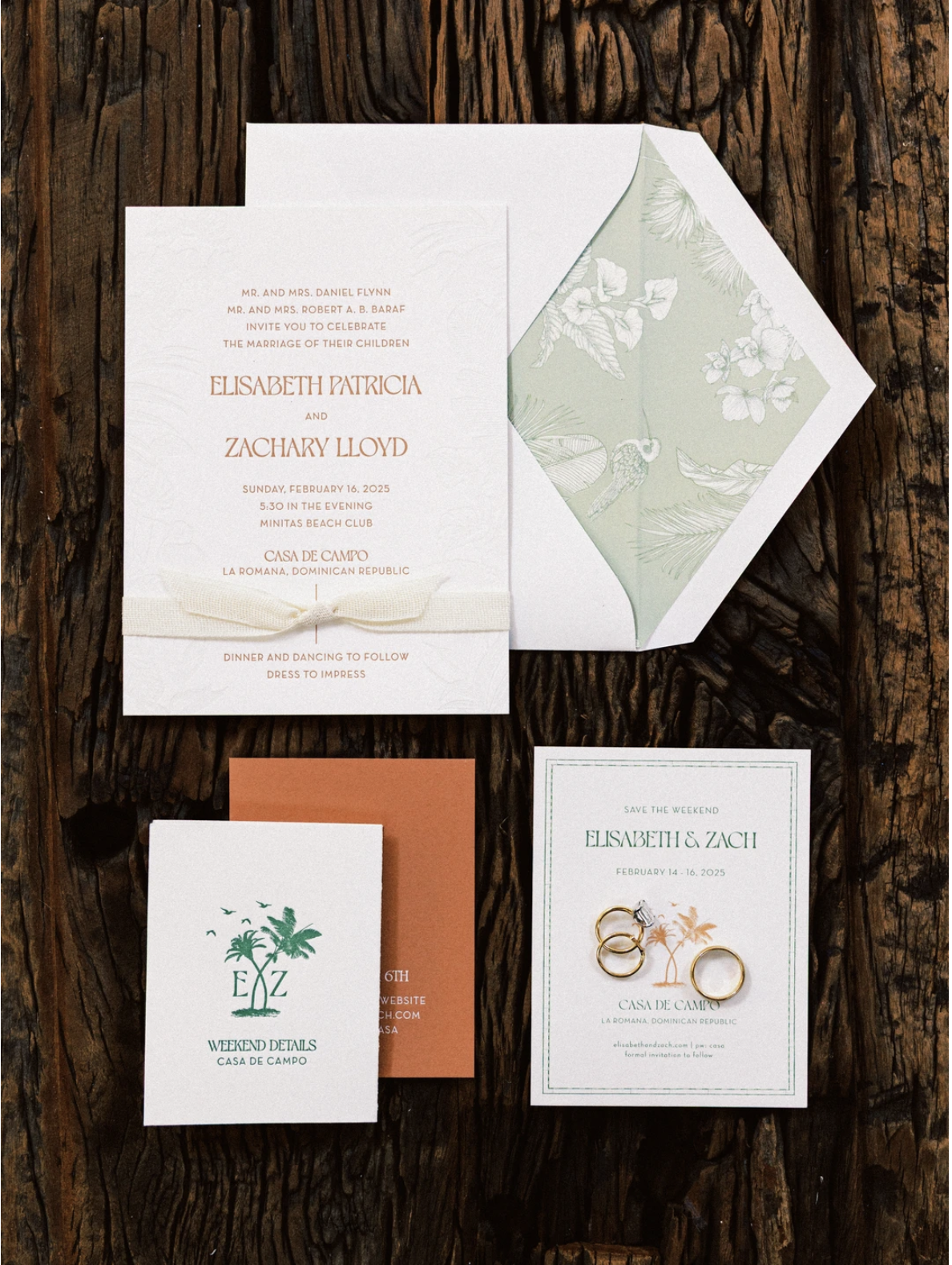
If both families are hosting, the names of both sets of parents can appear at the beginning of the invitation, followed by the request for attendance and the couple’s names. The wording should be arranged to reflect the actual hosting circumstances, rather than assuming that one family must take precedence.
When the couple is hosting, the invitation can begin with their own names:
Althea Rose Smith
and
Rebekah Morris -Singh
request the pleasure of your company
at their wedding
This is a straightforward way to maintain a formal tone without naming parents as hosts. Alternatively, “Together with their families” can precede the couple’s names when they wish to acknowledge their families without listing everyone individually.
The important distinction is that the host line identifies who is extending the invitation, it is not simply a list of family members.
Below is a layout honoring the non-hosting parents as well:
Mr. and Mrs. William Smith
request the honor of your presence at the marriage of their daughter
Althea Rose
to
Mr. Jerome Alexander Wilson
son of Mr, and Mrs. Curtis Wilson
“Honor of your presence” or “pleasure of your company”?
This is one of the most recognizable distinctions in traditional wedding invitation wording. The phrase “request the honor of your presence” is traditionally used when the ceremony takes place in a house of worship. For a ceremony held elsewhere, “request the pleasure of your company” is the conventional alternative. The difference is subtle, but it is a meaningful traditional convention. If you are working toward a particularly formal invitation, it is worth considering the ceremony setting before choosing the request line.
“At the marriage of” versus “at the wedding of”
Both phrases are appropriate, but they have slightly different associations. “At the marriage of” is a traditional choice for formal invitations, while “at the wedding of” feels more contemporary and conversational. Similarly, “as they are united in marriage” is another formal option, whereas “as they celebrate their wedding” is more relaxed. The wording should sound natural alongside the rest of the invitation, mixing highly formal language with casual phrases can make the invitation feel inconsistent, so it is helpful to establish the tone before finalizing the text.
How should the date and time be written?
For a traditional formal invitation, the date and year are spelled out in full. The day of the week and the month begin with capital letters, while the year is written in lowercase. The word “and” is omitted from the year.
Saturday, the fifteenth of May, two thousand twenty-seven
By contrast, “Saturday, May 15, 2027” is a common contemporary presentation.
Again, either option can serve its purpose, what matters is consistency across the invitation and any accompanying cards. Traditional formal invitations also spell out the time rather than using numerals and abbreviations. For example, “at half after four o’clock” follows the classic wording convention for 4:30. The phrase “half after” is preferred in traditional American formal etiquette over “half past” or “four-thirty.” You will also often see the time written without “in the afternoon” or “in the evening,” since the wording itself and the context can make the time clear, but it can be perfectly acceptable to include this for extra clarification.
One detail to avoid in a strictly traditional invitation is writing the time as “4:30 PM” while spelling out every other detail, as the mix of numerical and written formats can feel inconsistent.
How should the venue and location be written?
For formal invitations, the venue’s name is typically written in full, followed by the city and state. The state should also be spelled out rather than abbreviated.
The Mountain Inn
Lenox, Massachusetts
If the venue name and location are sufficient for guests to identify the ceremony site, the street address may not be necessary on the main invitation. It can be included on a details card when appropriate. The same principle applies to reception information. If the reception follows immediately at the same location, a simple “Reception to follow” may be sufficient. If the reception is at a different venue, a separate reception card allows you to provide the address and details without crowding the main invitation.

Abigail Fenton Photography
A note on addressing your envelopes - aka - let’s whip that guest spreadsheet into shape!
Traditional formal invitations often use titles such as “Mr.,” “Mrs.,” and “Dr.” and include full names when addressing guests. Titles are not required on every contemporary invitation, and many couples prefer to use full names without them, or a hybrid version noting both first names of a couple with titles. The key is to make a deliberate choice rather than mixing formats without a reason. Family circumstances can also affect the wording. Divorced parents, remarried parents, stepparents, and families sharing hosting responsibilities may require a more individualized approach. There is no need to force every family into one traditional template; the wording should reflect the people who are actually extending the invitation and the relationships the couple wishes to acknowledge.
Our friends the Smiths could be referred to in any of the following ways on an envelope addressed to them:
Mr. and Mrs. William Smith || Mr. William and Mrs. Susan Smith || William and Susan Smith | | Bill and Sue Smith
Were the Smiths to share the same gender identity, we may use pluralized titles in the most formal iteration:
Messrs. William and John Smith / Mmes. Susan and Tamara Smith
3. Ceremony Programs
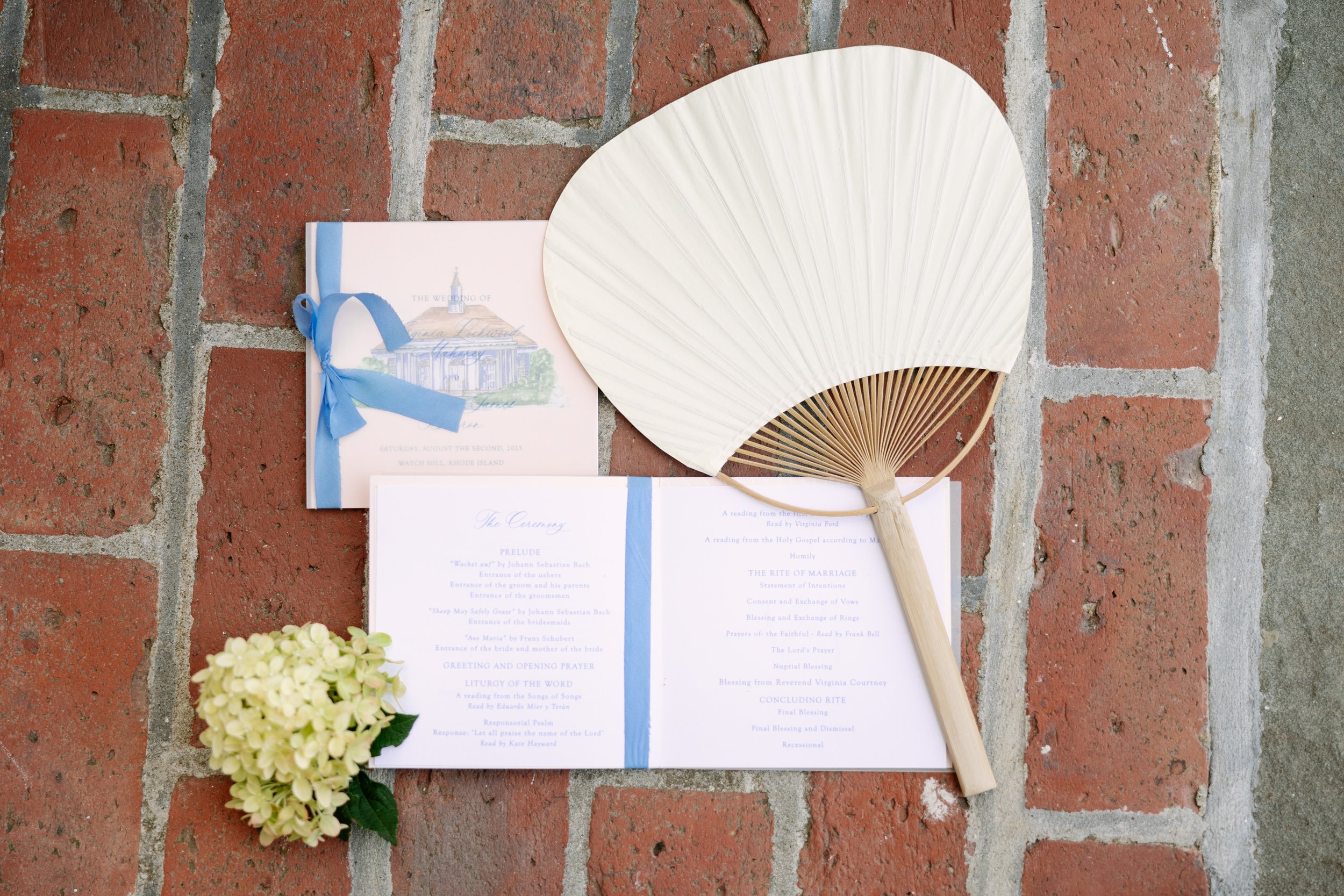
Ceremony programs have a different purpose from invitations, and their wording should reflect that. Rather than formally requesting guests’ attendance, a program guides them through the ceremony, identifies the participants, and provides context for the readings, music, and traditions that make the event personal. The language can be traditional, but it should also be functional. Guests should be able to understand the order of the ceremony at a glance.
How should the ceremony be listed?
The program typically begins with the couple’s names, followed by the date and location of the ceremony. Next up is a list of the entire wedding party, and then the order of events comes next.
For example:
Prelude
Processional
Welcome and Opening Remarks
Reading
Exchange of Vows
Exchange of Rings
Pronouncement
Recessional
The exact sequence should reflect the ceremony itself. A religious ceremony may include additional elements, such as prayers, hymns, blessings, or a nuptial mass, while a civil ceremony may use a simpler order of events.
Eric Dush Photography
Should the program say “bridal party” or “wedding party”?
The terminology you choose should reflect the people participating in the ceremony. “Bridal Party” and “Wedding Party” are both commonly used headings. “Wedding Party” is more inclusive, while “Bridal Party” may feel appropriate for a celebration that uses traditional bridal terminology. Individual roles can then be listed beneath the heading, such as Maid of Honor, Best Man, Bridesmaids, Groomsmen, Flower Girl, Ring Bearer, and Officiant. Be consistent with capitalization and titles throughout the list. If you use formal titles for some participants, consider whether the same treatment should apply to others.
How should readings and musical selections be credited?
When including a reading, list its title and author where appropriate. For a musical selection, include the title and composer, or the performer when relevant. These details give guests a fuller understanding of the ceremony and acknowledge the people who created the work.
Reading
“The Art of Marriage”
by Wilferd A. Peterson
Or:
Processional
“Canon in D”
Johann Pachelbel
The formatting should be consistent from one entry to the next. If one reading includes both its title and author, it is worth following the same structure for other readings.
Should the program contain the full transcribed text of readings, prayers and vows?
The short answer is: maybe. The ceremony program is not just for your guests to follow along, it is also a historical record of this moment in your lives - a future piece of family folklore. If you selected a reading because it is especially meaningful to you as a couple, or you wrote personal vows to each other, or if a certain prayer or blessing has always been a family favorite, future you may want to see those things in full detail. If you are a “let’s get this ceremony part over with” couple, then a multi-page program wouldn’t be a priority, and sticking with the basics is perfect.
Should the program include a memorial or acknowledgment?
A ceremony program may include a brief dedication to loved ones who have passed away, a thank-you to family and friends, or a short explanation of a meaningful tradition. These additions are personal choices rather than formal requirements. If you include a memorial, a heading such as “In Loving Memory” or “We Remember” can introduce the dedication. The accompanying text should be brief enough to fit naturally within the program. For acknowledgments, “Thank You” or “A Note of Gratitude” are simple options. The language can be more personal here than on a formal invitation, as long as it suits the tone of the celebration.
The Words Matter as Much as the Paper
Wedding wording is one of those details that can seem straightforward until you begin making decisions about individual phrases, names, dates, and titles. Understanding the traditional conventions makes those decisions easier and gives you a foundation for creating a stationery suite that feels cohesive.
At Robinson Press, we approach wedding paper as a complete visual language. The wording, typography, printing, and materials should all work together to tell your story. Sometimes that means following traditional etiquette closely; other times, it means adapting a convention to reflect the way you celebrate today.
The goal is never to add formality for its own sake, it’s to make sure every word has a purpose and every detail feels considered. When the language is right, the design can do what it does best: bring everything together beautifully.